Natural Diamond vs Lab-Grown Diamond: Same Properties, Different Origin
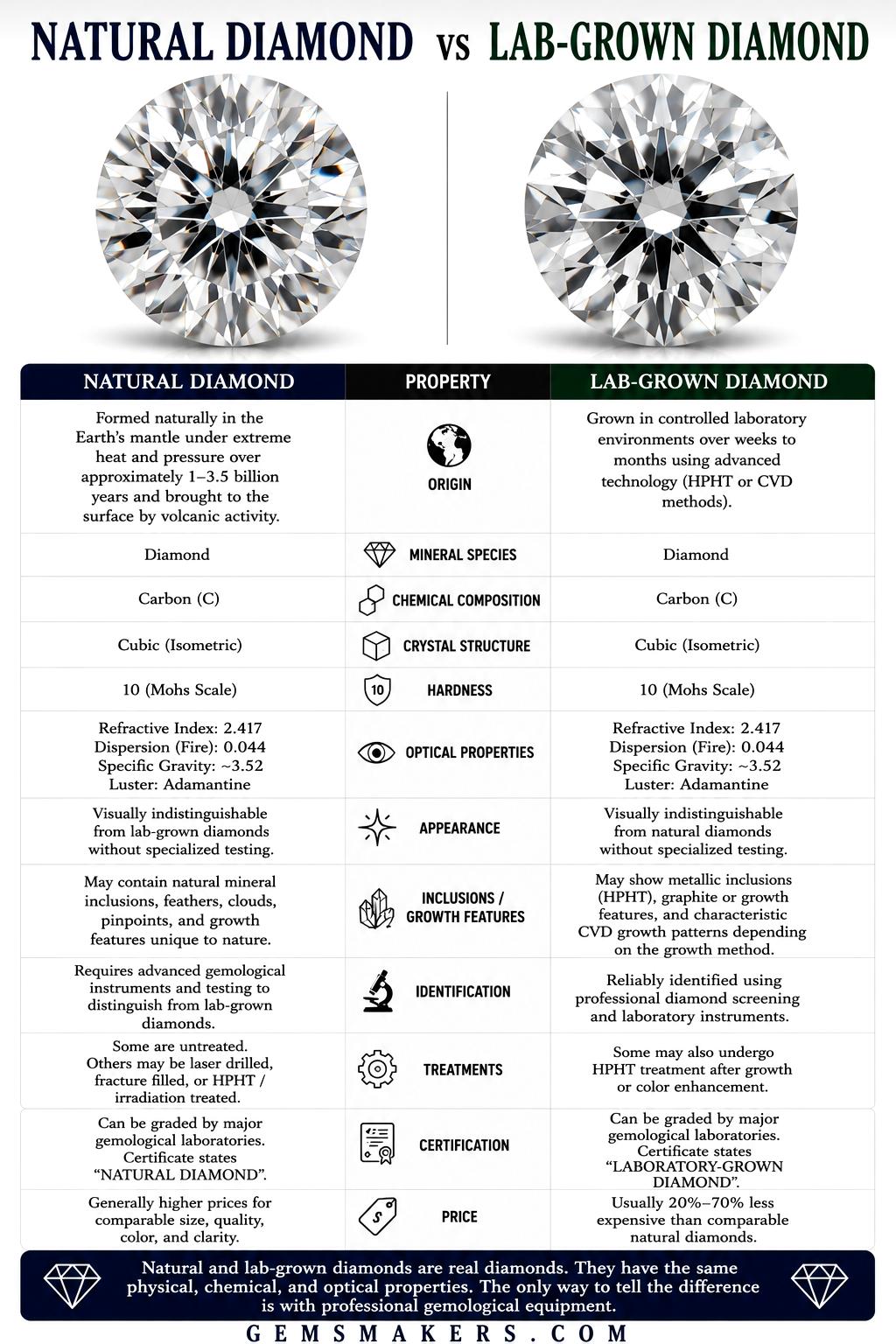
Natural diamond and lab-grown diamond are both real diamonds. They have the same mineral species, the same chemical composition, the same crystal structure, the same hardness, and the same essential optical properties. The main difference is origin. Natural diamonds form deep in the Earth over billions of years, while lab-grown diamonds are created in controlled laboratory environments using HPHT or CVD methods. Visually, they can look extremely similar, and specialized testing is usually needed to tell them apart.
Quick Answer
Natural diamonds are formed in the Earth’s mantle over immense time and brought to the surface by volcanic activity. Lab-grown diamonds are produced in laboratories using advanced technology. Both are real diamonds, but natural diamonds are usually more expensive, while lab-grown diamonds are generally more affordable.
Natural diamonds belong to the diamond species and are made of carbon. They grow in the cubic crystal system and rank 10 on the Mohs hardness scale. Lab-grown diamonds share those same core properties because they are also diamonds. That is why both types can be cut, polished, and graded in ways that are nearly identical. The difference is not in what they are. The difference is in how they formed.
A natural diamond is created under extreme heat and pressure deep inside the Earth. The process takes approximately 1 to 3.5 billion years. After formation, volcanic activity brings the crystals closer to the surface. A lab-grown diamond is made in a much shorter time, usually over weeks to months, in a controlled setting. HPHT and CVD are the two main growth methods. HPHT recreates high pressure and high temperature conditions. CVD grows diamond from a carbon-rich gas environment. Both methods produce genuine diamonds.
The chart shows that natural and lab-grown diamonds share the same refractive index, dispersion, specific gravity, and luster. Both have a refractive index of 2.417, dispersion of 0.044, specific gravity of about 3.52, and adamantine luster. That is why they sparkle in very similar ways. To the eye, they can be difficult to distinguish without professional equipment. Their appearance may be visually indistinguishable unless a trained gemologist uses the right tools.
Inclusions and growth features are one of the main clues used in identification. Natural diamonds may contain mineral inclusions, feathers, clouds, pinpoint features, and natural growth characteristics. Lab-grown diamonds may show metallic inclusions, graphite, or growth patterns that depend on the method used. Even then, identification is not always simple. Professional gemological testing is the reliable way to tell whether a stone is natural or lab-grown.
Certification is also important. Natural diamonds can be graded by major gemological laboratories, and the certificate will state “Natural Diamond.” Lab-grown diamonds can also be graded by major labs, but the certificate will state “Laboratory-Grown Diamond.” That distinction matters because the market treats the two differently, even though both are real diamonds.
Price is one of the biggest differences. Natural diamonds are generally more expensive for comparable size, color, and clarity. Lab-grown diamonds are usually 20% to 70% less expensive than similar natural diamonds. That makes lab-grown diamonds attractive to buyers who want a larger stone or a lower price point. Natural diamonds remain more valuable because of their geological rarity and long-form natural origin.
When people shop for diamonds, the choice often comes down to preference. Some buyers want the history, rarity, and natural origin of a diamond formed inside the Earth. Others prefer the value, size, and controlled quality of a lab-grown diamond. Both can be beautiful in engagement rings, pendants, earrings, and fine jewelry. Both can be brilliant. Both are genuine diamonds. The decision depends on what the buyer values most.
Natural diamond and lab-grown diamond are not the same in origin, but they are the same in species and essential physical properties. One comes from the Earth. One comes from a laboratory. That single difference shapes their value, rarity, and story.
Looking for natural loose gemstones, collector stones, and jewelry-grade gems?
← Back