Gemstones With Incredible Inclusions: Nature’s Most Beautiful Internal Patterns
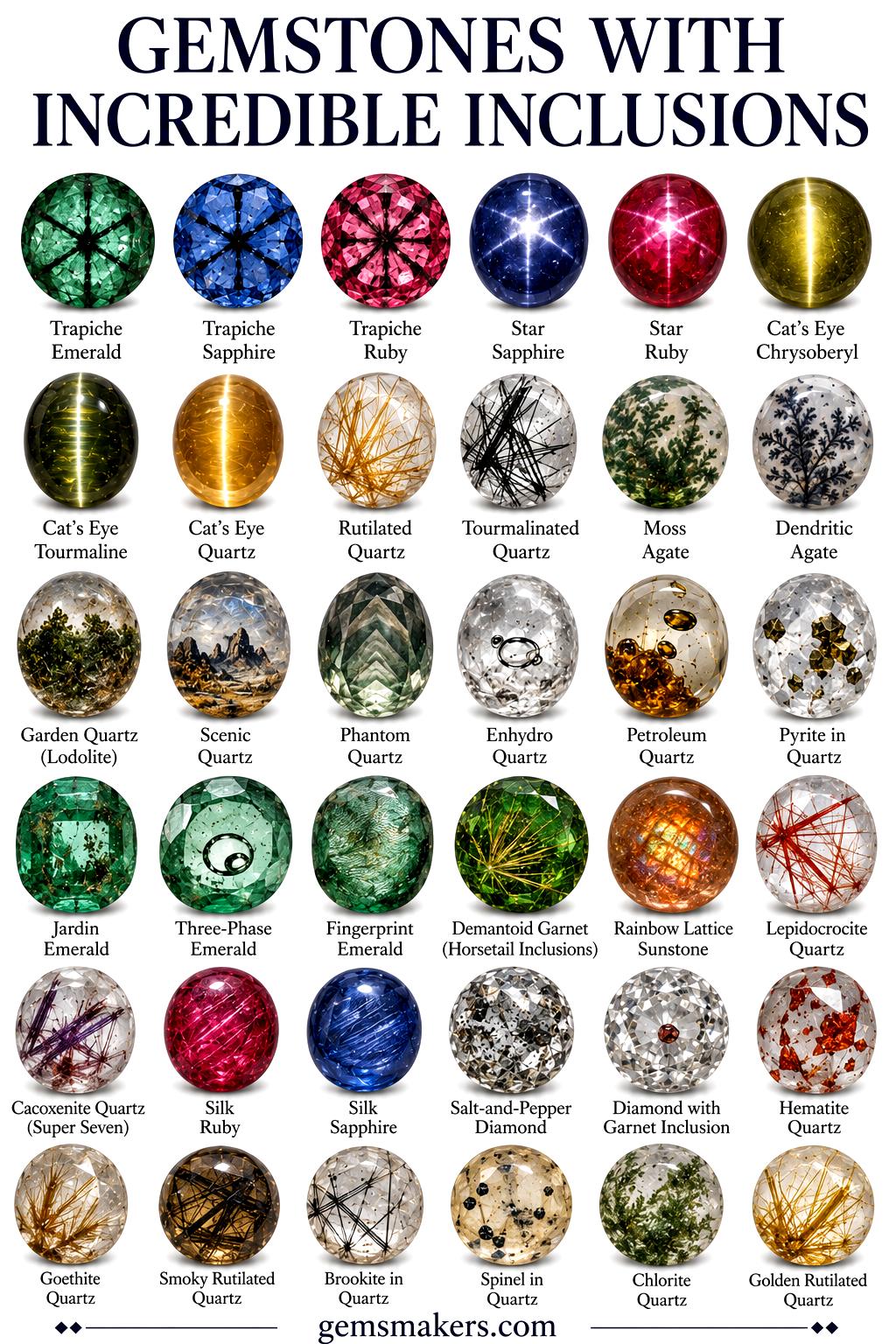
Gemstones with incredible inclusions are stones where the inside is just as interesting as the outside. In this group, the inclusion itself becomes part of the beauty. That is why stones like trapiche emerald, star sapphire, star ruby, cat’s eye chrysoberyl, cat’s eye quartz, rutilated quartz, tourmalinated quartz, moss agate, dendritic agate, garden quartz, scenic quartz, phantom quartz, enhydro quartz, petroleum quartz, pyrite in quartz, jardin emerald, three-phase emerald, fingerprint emerald, demantoid garnet with horsetail inclusions, rainbow lattice sunstone, lepidocrocite quartz, cacoxenite quartz, silk ruby, silk sapphire, salt-and-pepper diamond, diamond with garnet inclusion, hematite quartz, goethite quartz, smoky rutilated quartz, brookite in quartz, spinel in quartz, chlorite quartz, and golden rutilated quartz are so loved by collectors and jewelry buyers. These gems are not valuable in spite of their inclusions. In many cases, they are valuable because of them.
Quick Answer: Gemstones with incredible inclusions are natural gems that contain internal features such as needles, crystals, liquids, growth patterns, clouds, or star and cat’s eye effects. These inclusions can create unique beauty, rarity, and collector value.
What makes this category so interesting is that no two stones look exactly the same. A rutilated quartz can show gold, black, or smoky needles. A moss agate can look like a tiny natural landscape. A garden quartz can feel like a miniature world trapped inside crystal. A star sapphire or star ruby can show a bright star effect when light moves across the surface. A trapiche emerald can display a striking radial pattern that looks almost geometric. These are the kinds of stones that make people stop and look twice.
Some inclusions are optical, meaning they create special light effects. Star sapphire, star ruby, and star spinel show asterism, which is the star-like reflection seen under direct light. Cat’s eye stones like chrysoberyl cat’s eye and cat’s eye tourmaline show chatoyancy, where a bright band moves across the surface. These effects are highly prized because they are rare, beautiful, and immediately recognizable. Other inclusions are scenic or decorative, like dendritic agate, moss agate, and jardin emerald, where the internal pattern looks like plants, trees, or garden scenes.
Quartz is one of the best-known gemstone families for incredible inclusions. Rutilated quartz is famous for its golden or dark needle-like inclusions. Tourmalinated quartz has black or dark needle lines inside clear quartz. Phantom quartz shows internal growth outlines that look like ghost crystals inside the stone. Enhydro quartz contains tiny fluid or bubble features that can move in rare examples. Petroleum quartz contains natural hydrocarbon inclusions that give it a special collector story. Lepidocrocite quartz, hematite quartz, goethite quartz, and brookite in quartz all show how many different internal minerals can appear in one crystal family. This makes quartz one of the most exciting materials for inclusion lovers.
Emerald is another gemstone family where inclusions are often part of the story. Jardin emerald, three-phase emerald, and fingerprint emerald are especially interesting to collectors. Emeralds commonly contain natural internal features, and those features are often expected and appreciated rather than seen as flaws. In fact, the internal character can help show that the stone is natural. Demantoid garnet with horsetail inclusions is another famous example. The horsetail pattern is one of the most admired inclusion features in the gemstone world because it can give the stone extra identity and collector appeal.
Some gems in this category are loved because the inclusion gives them a landscape-like or artistic appearance. Moss agate and dendritic agate are perfect examples. Their internal patterns can look like trees, ferns, branches, or tiny underwater scenes. Garden quartz and scenic quartz are similar, but they often look even more dramatic, with colorful or layered internal material that gives a miniature world effect. These stones are very popular with collectors because they feel natural, imaginative, and deeply individual.
There is also a special group of stones where inclusions make the gem look alive with movement and light. Rainbow lattice sunstone is one of the most famous examples. Its internal structure creates a shimmering pattern that can flash in a very unusual and attractive way. Silk ruby and silk sapphire contain fine internal silk that can affect the gem’s appearance and contribute to optical effects. Spinel in quartz, chlorite quartz, smoky rutilated quartz, and golden rutilated quartz all show how inclusions can add depth, texture, and visual drama to otherwise transparent stones.
Salt-and-pepper diamond and diamond with garnet inclusion are especially interesting because diamonds are often thought of as perfectly clean, but included diamonds have their own appeal. Their dark or speckled internal features can give them a bold, modern look. They are often chosen by buyers who like a more natural or raw appearance. These stones show that beauty in gemstones is not always about perfect clarity. Sometimes personality is more valuable than purity.
In jewelry, included gemstones are often used as cabochons, beads, and collector cuts because those shapes best show the internal pattern. Some are faceted too, especially if the inclusion pattern still looks attractive when cut. Buyers who love gemstone inclusions often want stones that feel one-of-a-kind. That is exactly what this category offers. The inclusion becomes a signature, and the stone becomes a natural artwork.
For gemstone sellers, this is a powerful category because it is easy to explain and visually strong. People search for included gemstones, unique gemstone inclusions, rare inclusion stones, star gemstones, cat’s eye gemstones, rutilated quartz, moss agate, dendritic agate, trapiche emerald, and scenic quartz because they want something different from standard clean gems. The internal pattern often becomes the first thing they remember. That makes these stones especially useful for product pages, educational posts, and collector-focused listings.
Frequently Asked Questions
What are gemstone inclusions?
Gemstone inclusions are natural features inside a gemstone, such as crystals, needles, clouds, liquid, gas bubbles, growth patterns, or other mineral material. Some inclusions reduce clarity, but others create special beauty and collector value.
Are inclusions always bad?
No. In many gemstones, inclusions are part of the appeal. They can create cat’s eye effects, star effects, scenic patterns, needle patterns, and rare collector looks.
Which gemstones are famous for inclusions?
Rutilated quartz, tourmalinated quartz, moss agate, dendritic agate, trapiche emerald, star sapphire, star ruby, cat’s eye chrysoberyl, garden quartz, phantom quartz, and demantoid garnet are some of the most famous inclusion gemstones.
Why do collectors like included gemstones?
Collectors like them because each stone is unique. The internal features make the gemstone look like a miniature natural artwork.
Are included gemstones good for jewelry?
Yes. Many included gemstones are used in jewelry, especially cabochons, pendants, and statement rings. They are often chosen for their character and natural beauty.
Final Thoughts
Gemstones with incredible inclusions show that beauty in nature is not always about perfect clarity. Sometimes the most interesting stones are the ones with patterns, needles, clouds, stars, or tiny mineral worlds inside them. These internal features give the stone a personality that clean gemstones cannot always match. That is why included gemstones remain so popular with collectors, designers, and gemstone lovers. They feel alive, natural, and completely individual.
Looking for natural loose gemstones, collector stones, and jewelry-grade gems?
← Back